
Remote, Hybrid, or In-Person: Choosing Your Focus Environment
The debate usually treats this as one decision for an entire company. It's actually a decision that changes by the task, and sometimes by the hour.

The remote-versus-office debate is usually framed as a single company-wide policy: everyone in three days a week, or nobody in at all. That framing misses the more useful question underneath it, which isn't about company policy at all — it's about which environment actually suits the specific work in front of you, right now, today.
Different work wants different environments
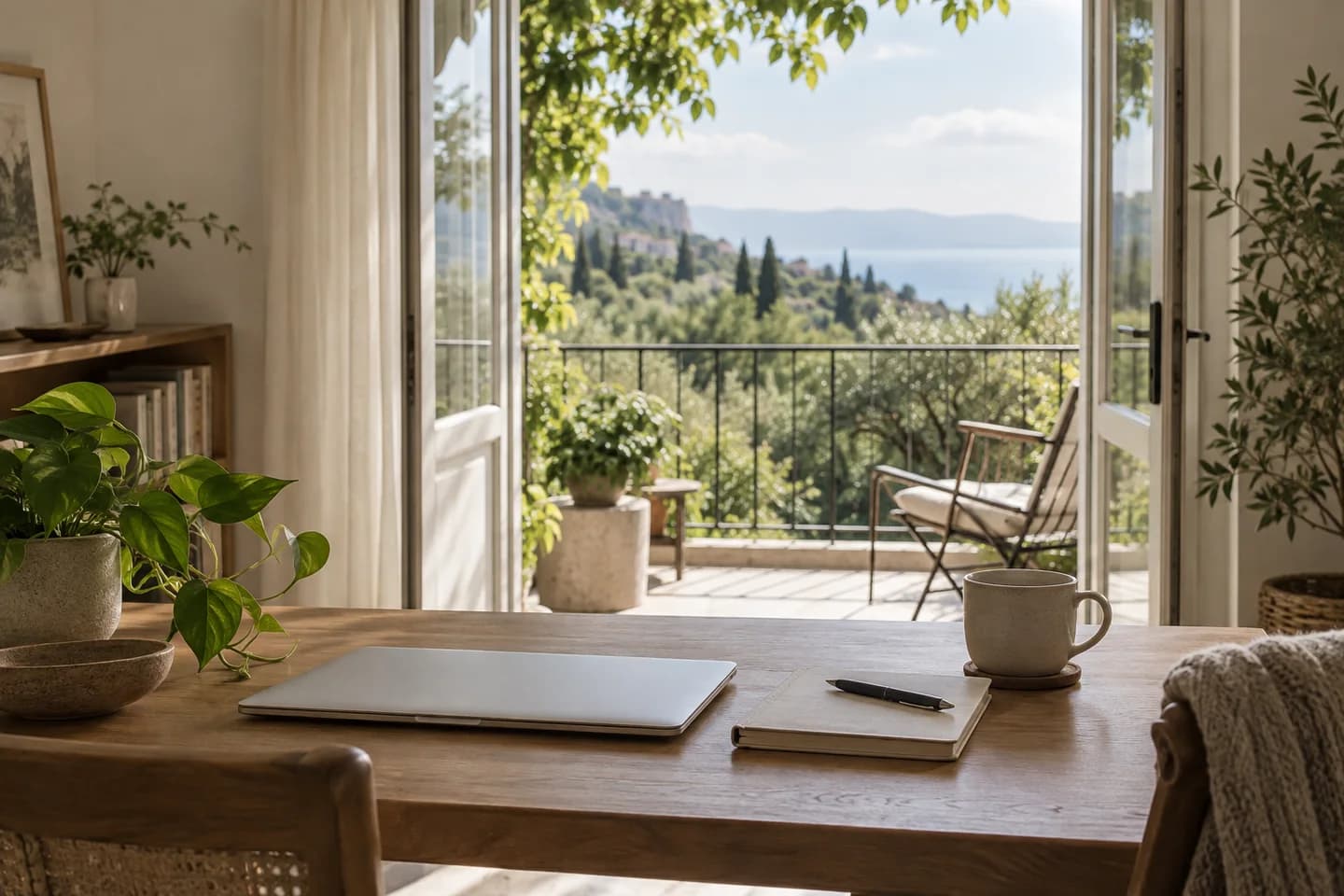
Deep, single-threaded work — writing, coding, analysis — tends to do best somewhere quiet, low-interruption, and free of the social pull to chat. That can be a home office with the door closed, or it can be a quiet coworking room; what it can't be is an open-plan office at 10am when everyone's back from the coffee machine at once.
Collaborative work — a design review, a planning session, anything that benefits from quick back-and-forth and reading a room — tends to do best in person or on a live call, where the friction of a written message would slow down a conversation that wants to move fast.
Most jobs are a mix of both in a single week, sometimes a single day. Treating "remote" or "in-office" as one answer for all of it is like asking whether a kitchen should be designed for cooking or for eating — it needs to do both, at different times, and the mistake is assuming one layout has to serve every moment.
The honest case for hybrid
Hybrid isn't a compromise between two better options. Done well, it's a recognition that the two kinds of work above genuinely want different settings, and a good week gives you access to both without forcing a single space to be everything. The failure mode isn't hybrid itself — it's a hybrid policy that doesn't actually change what people do on office days versus home days, so the office ends up hosting the same solo, heads-down work that would have been better off at home, quiet and undisturbed, and nobody gets the benefit either kind of day was supposed to provide.
What to actually optimize for
Instead of asking "where should I work," a more useful question is: what does this specific task need? A task that needs silence and no interruptions wants a quiet room, wherever that room is. A task that needs a real conversation wants people in the same place, or at least the same call. A task that needs the ambient presence of other focused people — not conversation, just company — wants a shared focus space, which is a category most remote setups skip entirely, because it's neither "meeting" nor "silent home office." It's something in between, and it's often the missing piece.
The policy question — how many days in an office — is less important than the environment question, asked task by task. Get that right, and the policy mostly takes care of itself.